 LinkedIn
 WeChat
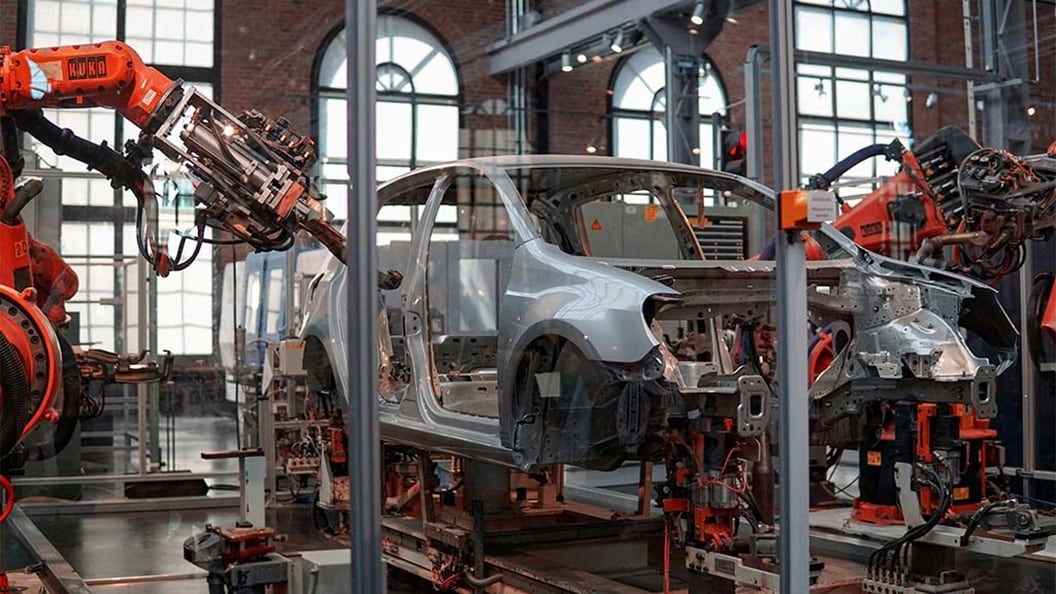
The rise of electric and software defined vehicles (SDVs) is transforming the automotive industry. But the introduction of new suppliers, harder-to-source manufacturing components, and rapid digital transformation has brought with it a host of new risks to already complex global supply chains.
According to Maersk’s latest research, Course for Change, automotive was the global industry worst hit by disruption in the past fiscal year, with companies reporting an average loss of 4.7% of revenue.
With transformation-linked challenges aggravating uncertainty, resilience has become a competitive imperative. Achieving it demands a fundamental rethink of supply chain strategy, centred on agility and security of supply.
Our research, which draws on the findings of 190 senior logistics and supply chain professionals in the automotive industry, compares the responses to disruption of ‘frontrunners’ (highly resilient companies with revenue losses of under 1% in their past fiscal year) and ‘followers’ (who faced losses of more than 5%).
An industry in flux
Electrification and digitalisation are rewriting the rules for automotive OEMs. Electric vehicles (EVs) require fewer components than their internal combustion engine (ICE) counterparts, but they rely on scarce inputs such as lithium, cobalt and rare earth metals. These are harder to source and concentrated in a limited number of geographies. Moreover, they link mining – a sector struggling to comply with ESG requirements – into the OEM supply chain.
SDVs bring similar pressures from different directions. Software and batteries are now as critical as mechanical components, and a dependence on chips and semiconductors tie the industry directly to the electronics ecosystem – a sector particularly exposed to geopolitical and trade instability.
As well as managing new risks, OEMs must manage new suppliers and markets, demanding a rethink of strategy. Frontrunners are already acting: 95% say supply chain and procurement must shift focus from the movement of goods to logistical strategy. But only 70% of followers agree. So, where should OEMs focus their efforts?
Reassessing risk
As the automotive supply chain extends into riskier markets, the volume and intensity of challenges are multiplying. Regulators, customers and investors are watching more closely than ever. Frontrunners recognise this shift: 41% rank regulatory compliance and risk management among the top skills required for supply chain resilience, compared with just 28% of followers.
Governance is also becoming more demanding. Increasingly, manufacturers are being audited not only on their own compliance, but on that of their suppliers. Kersten Janik, COO at WITTE, explains: “Our customers now check not only whether we are complying with regulation, but also whether we are auditing our own suppliers further down the chain to ensure that they are doing the same.”
Despite growing pressure, however, our survey results suggest that most automotive companies are not prepared for this. Just 34% of automotive companies are conducting regular third-party audits of suppliers for compliance assurance.
How can OEMs build their capabilities in this area? Real-time visibility is key. “We use the term ‘supply chain,’ but what we’re describing isn’t really a chain anymore – it’s a network,” explains Jenny Zhang, head of automotive supply chain management at Aumovio. “In order to build resilience, you need visibility over that network. And that doesn’t just mean direct suppliers. You need to know what’s happening at tier 2. Digital tools for end-to-end tracking and visibility have been instrumental in helping us to achieve this.”
Frontrunners are already ahead in terms of visibility. Half are investing in visibility tools, versus just over a third (34%) of followers.
An innovative approach to relationships
Tools alone are not enough to achieve end-to-end visibility of today’s automotive supply chain. To obtain much of the data required to anticipate disruption, OEMs must be willing to collaborate. A significant 64% of frontrunners are working with their logistics service providers (LSPs) to exchange real-time data and insights about supply chain events, risks and performance. Less than half (48%) of followers are doing the same.
Frontrunners also realise the crucial role of these partnerships in managing increased compliance risk: they are twice as likely as followers to cite compliance as a key area in which LSPs can support resilience.
Services for visibility and resilience
- East-West network
Our ocean freight system harnesses a hub-and-spoke shuttle model that aims to exceed 90% scheduling reliability on East-West ocean lanes. - Delivery guarantee
Our premium delivery guarantee service for critical shipments uses asset control and integration capabilities to reroute deliveries, reprioritise cargo, and change transportation modes to mitigate the impacts of extreme operational disruptions. - Control towers
Part of our suite of supply chain management tools, control towers offer exceptions-based monitoring to detect issues, provide rerouting options and act on behalf of our customers. - Visibility studio
Our real-time shipment tracking solution provides predictive and actionable insights into disruption, congestion, lead-time reliability and detention management on a single platform, helping customers make informed decisions. - Supply chain resilience model
Our customisable model harnesses real-time visibility and predictive insights to manage disruption, enhance operations, and ensure supply chain continuity.
Relationships with suppliers are just as critical, but dynamics are changing. “Ongoing challenges have fundamentally changed the nature of the OEM-supplier relationship,” explains Jenny Zhang. “Where, previously, communication was largely restricted to orders and feedback, the relationship is now much more dynamic.”
Powerful technology suppliers such as NVIDIA, Apple, and Huawei – who control access to technologies essential to SDVs – are now key players in the automotive supply chain. This means manufacturers can no longer rely on a superior position in the hierarchy to dictate terms. Rather, they must take a collaborative, peer-driven approach to supplier relationships to ensure resilience.
As electrification and digitalisation reshape supply chain dynamics, OEMs’ resilience will hinge on their ability to manage increasingly complex risks. Those that can combine visibility and collaboration will be best placed to succeed.
Four supply chain strategies for automotive OEMs
- Map and trace: Extend visibility to minerals and electronics suppliers and integrate ESG due diligence into resilience planning.
- Invest in digital tools: Use AI, digital twins, and control towers to anticipate risk, manage complexity and facilitate real-time decision making.
- Partner for visibility: Collaborate with LSPs and suppliers to share data and strengthen compliance across supply chain tiers.
- Balance people, processes, technology: Build a culture of collaboration and resilience that can keep pace with supply chain transformation.
Be ready for intelligent supply chain resilience to go all the way! Explore the full Course for Change report and learn more about Maersk Supply Chain Resilience Model, or for more logistics trends and insights, read and download The Logistics Trend Map.

About FT Longitude
At FT Longitude, we harness the power of intelligence with influence to leave a lasting impression on the world of business. With a focus on pioneering thought leadership strategies, we create high-impact campaigns that transform perceptions. We craft powerful insights that engage key decision-makers, and using creative storytelling techniques, we imprint brands with unforgettable messages that resonate. Part of the Financial Times Group, we help brands reach and connect with the world’s most influential people, through the FT’s 21 million monthly global readers. Visit longitude.ft.com and find us on social media.