LinkedIn
 WeChat
- Already today, newest electric trucks can replace diesel vehicles in 95% of all user cases in Europe
- In fuel & maintenance costs EV trucks are already cheaper than diesel vehicles
- China is leading the way with over 30% share of EVs in total sold heavy-duty tractor/trailer trucks
- Going forward, factors like decreasing CAPEX should accelerate the switch to EV trucks
- Besides cost savings and potential reduction in GHG emissions (especially when powered by renewables), there are also significant benefits for drivers and employees working in areas with high concentrations of trucks
Road transport is one of the largest emitters of greenhouse gas (GHG) emissions globally. In the European Union fossil fueled road transport caused close to 750 million tons of carbon dioxide emissions in 2023, which was 23% more than in 1990. Of this, 39% came from the exhausts of light and heavy trucks as well as buses.
The biggest emitters in the transport sector typically include logistics companies that rely on trucks for landside transportation. Maersk alone organises a few million truck transports for its customers every year to keep their supply chains running from factories to end consumers.
These figures show that we have a very important but also huge task ahead of us since Maersk has the goal to achieve net-zero emissions by 2040, which also applies to the road transport we operate for our customers. From today’s perspective, electric trucks are the best feasible solution for the energy transition on roads from both a total cost of ownership and scalability perspective – even if you still don't see electric trucks that often in many countries.

However, for Kenny Kristensen, whose team is working on lowering GHG emissions of barge, rail and road transport, there is reason for optimism that this will change: “With the next generation of battery-electric trucks and the rapid advance of EV trucks in China, the development should soon gain much more momentum in other parts of the world,” the expert is certain. “The latest EV trucks have a range of more than 500km on a single battery charge, which covers roughly 95% of all daily user trips of a normal truck in Europe.”
There is a rapid acceleration in select countries in Europe and more broadly in China, where 30.3% of heavy duty tractor/trailer trucks sold already had an electric drive in H1 2025 while the share of diesel trucks dropped from 57 to 52% year on year. In Europe, on the other hand, the overall share of sold EV trucks is still just 2.1%, and in the US even less: only 0.5% of newly registered trucks in Q1 2025.
Kenny Kristensen identifies higher CAPEX as one of the key remaining obstacles for electric trucks, which in Western countries are still 2 to 2.5 times more expensive than comparable diesel units. “However, competition in this still young market segment should increase sooner rather than later. Existing and new producers will enter the markets with competitive models, which we welcome and which should reduce prices for EV trucks over the next years,” Kenny Kristensen is certain. “This could become a catalyst for the transformation on our roads.”
Charging time is another concern: “It only takes 10 to 12 minutes to refuel a diesel trucks, while today charging EV trucks can take 2-4 hours,” he explains. But new and faster charging technologies are coming, such as the Megawatt Charging System (MCS) with 750 KW or the Twin CCS charging solution (up to 700 KW), enabling full charging (from 20 to 100%) in 30 to 45 minutes.
Battery range is not an issue anymore in most user cases
“As a rule, today’s range of EV trucks is already sufficient for the majority of daily operations, and charging typically takes place during parking periods anyway – during breaks for the driver or overnight,” he adds with reference to Maersk’s own EV trucks and operational experience. “We operate our electric trucks between 30km and up to 400km per trip.”
In terms of technology and range, operational parity between electric and diesel trucks has already been established for the majority of use cases, Kenny Kristensen says. “But shifting to a new technology with a different operating pattern is too complex and a challenge for many trucking companies, despite the potential cost savings and other benefits.”
Therefore, in some countries governments try to incentivize companies to explore the new technology by reducing or completely waiving taxes, registration fees and toll road charges for EV trucks. These measures lower operating costs that over time compensate for the still higher initial investment (CAPEX) for an electric truck, he explains. Another example of such an incentive is that diesel fuel is becoming more expensive in several geographies due to rising GHG emission fees. Owners of EV trucks don’t have to pay these GHG emission costs.
A recent comprehensive study by the world road transport organization IRU on Total Cost of Ownership (TCO) has shown that GHG emission fees and waived toll road fees make deploying EV trucks cheaper than diesel trucks in countries such as Germany, France and Poland. In Germany, the TCO of EV trucks can be up to 15 Euro-Cent less per kilometer compared to a diesel vehicle, the IRU study found. In Poland, the difference is between 5 and 10 Euro-Cent/km, and in France around 5 Euro-Cent/km.
While these incentives are great to nudge the industry to explore the energy transition and generate confidence across the ecosystem that the technology works, we are strong advocates that the EV trucks must be able to compete - and win - on equal terms with the fossil solutions without subsidies. The cost of transportation is a competitive factor for companies that we always strive to minimize.
Kenny Kristensen further elaborates: “We truly believe this is possible, but it does require that countries establish and maintain ambitious GHG emission reduction targets for road freight that – through investment and demand certainty – in return will enable cost reductions through economies of scale and increased competition.”
Furthermore, he sees the need to proactively upgrade the power supply from local grids as demand for power to charge the trucks is growing, enabling the most efficient truck operations possible and further reducing costs.
The advantages of EV trucks at a glance:
- Potential reduction in GHG emissions, with significant reductions especially when charging with renewable electricity
- No emission at the tailpipe of air pollutants such as NOx and particulate matter, which are harmful to human health
- Less noise pollution – especially during start-up and at lower speeds
- The drivers of electric trucks experience less fatigue compared to diesel trucks
Maersk EV trucking solutions in more than 14 countries globally
Today, EV trucks are being deployed by Maersk for its customers in more than 14 countries worldwide. This includes countries like China, India, Thailand, Vietnam, Saudi Arabia, USA, Brazil, Chile, Peru, and several European countries from Spain to Denmark and from UK to the Czech Republic. “In other countries we would always try and support our customers in finding EV trucking solutions for their inland logistics”, says Kenny Kristensen.
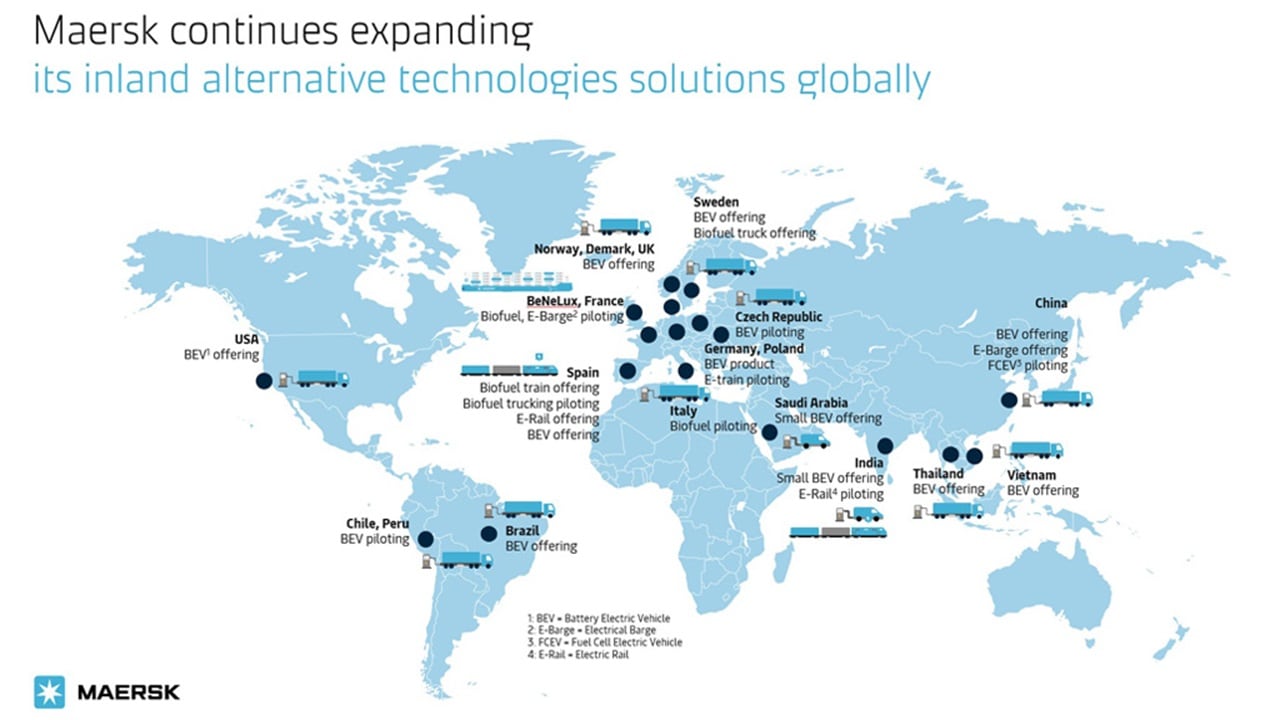
In most of the 14 countries, Maersk is cooperating with local trucking partners to unlock EV trucking solutions: They procure and operate the EV trucks, while Maersk ensures capacity utilization by its customers – such as the leading pump manufacturer Grundfos in Denmark or the leading Swedish supermarket chain ICA.
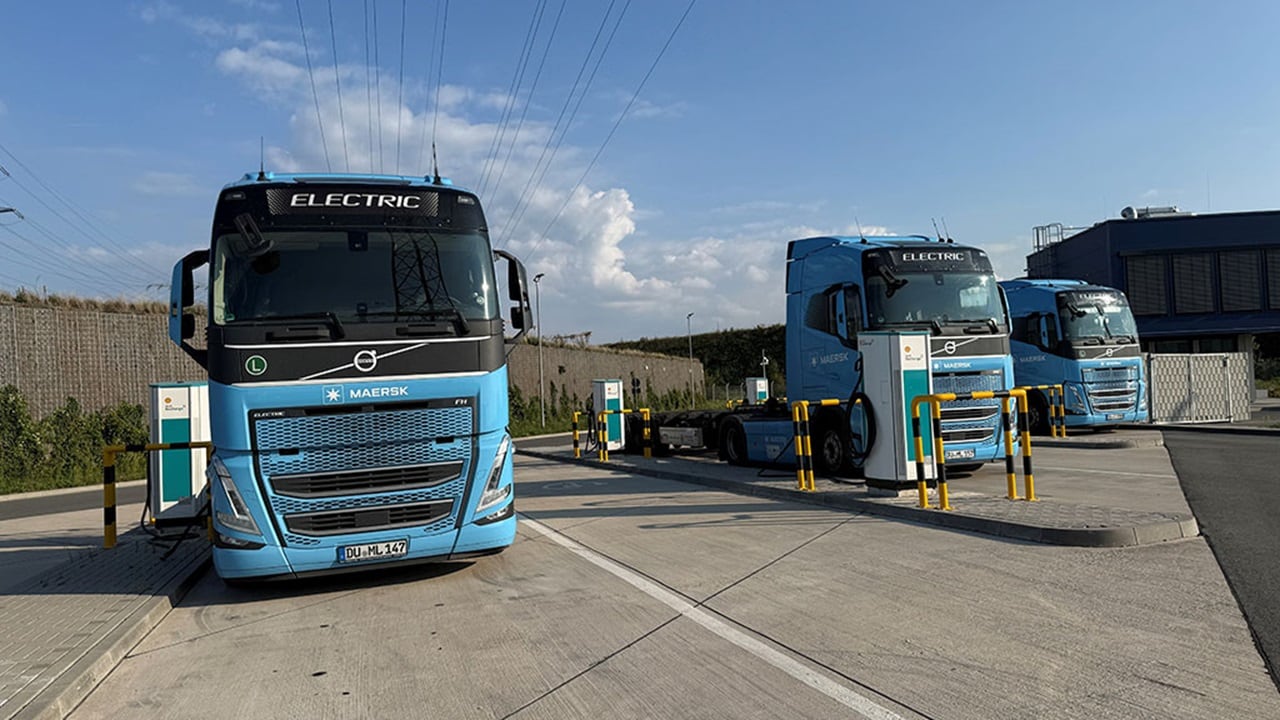
Maersk also maintains owned fleets of heavy-duty EV trucks, for instance in the US and in Germany. In Germany, for example, Maersk’s 25 electric Volvos are used by major customers from the automotive, fashion & lifestyle, chemical, tech and FMCG verticals like Beiersdorf. Pilots with other customers like Nestlé are ongoing.
The 25 units in Germany have already covered more than 2.7 million kilometers on German highways and state roads by the end of 2025, and the owned fleet in the US even 14 million kilometers. For German export cargo, trips from factories to the nearest intermodal rail station or directly to the ports of Hamburg or Bremerhaven play a key role. For import cargo, the EV trucks drive containers from ocean ports or Europe’s largest inland port in Duisburg to the customers' warehouses.
For Maersk's customers, the main focus is the reduction of GHG emissions when they rely on electric trucks. Many of them have ambitious net zero targets and defined pathways with short term goals. Reducing GHG emissions from logistics is often one of their strategies to reduce their overall GHG footprint.
After ocean freight port to port reduction, we really wanted to take the next step and also save emissions in pre-carriage of containers as well as the last mile to our plants or warehouse sites. The implementation of EV trucks on the roads in Denmark went very well and this is a good case for international expansion of EV trucks. In view of the dire climate consequences that we can see in the news almost every day, we cannot wait and must take action wherever we can. We as producers and exporters want to actively drive the topic of decarbonization of the supply chain and are pleased to partner with Maersk who is willing to try and implement new ways.
“What we do today in EV trucking is still small compared to what we need to achieve by 2040 for our net zero goal, but we see growing interest from many customers for EV trucking solutions,” Kenny Kristensen says. “To realise this we are, nevertheless, dependent on our trucking partners, because the transition to lower GHG emissions solutions in inland transport is a team effort. Here, you always move in an ecosystem with many partners involved.”
To promote and accelerate the overall deployment of EV trucks, Maersk is also focusing on knowledge sharing, especially with its trucking partners. For example, an EV Deployment Guideline with best practices and important learnings has been created in cooperation with the Smart Freight Center and is available on their library.