 LinkedIn
 WeChat
The logistics industry has long defined reliability by one key metric: on-time delivery. It’s easy to report and fits neatly into a spreadsheet. But in categories like Specialized LTL or Heavy-Bulky Delivery Services, that metric can be dangerously misleading. And often the wrong signal entirely. It tells you everything… except whether the delivery actually worked.
Because when timelines are met but expectations fall apart, it might be marked “on-time”, but your brand pays the price. And that’s where the real risk arrives. If you’re still measuring reliability by a single KPI, you’re not running a reliable operation. You’re just hoping for one.
The false sense of ‘reliable’: is ‘on-time’ enough?
Picture this: A $15,000 piece of manufacturing equipment arrives on Friday. On time. Delivered in full. On paper, the job’s done.
But the corner is dented. There are visible scratches across the equipment. The installation hardware is missing. There’s no explanation of what happened in transit. And your operations team is scrambling to contain a downstream mess that never should’ve happened.
So, was that a reliable delivery? The freight industry would say yes. Your business would say: absolutely not. For decades, reliability in freight delivery has meant only two things:
- Was it delivered in full?
- Was it delivered on time?
But what if it was dropped at the wrong door first? What if the customer chased updates all week? What if the product arrived in poor condition, or worse, the delivery experience damaged your brand reputation, not just the freight?
A delivery marked “complete” doesn’t always mean it was done right. And you know it.
For retail and marketplace operators needing to move customer-facing freight that is complex, high-value, fragile, or oversized, those old checkboxes simply don’t suffice. According to a survey, 85% of consumers say a poor delivery experience hurts their perception of the retailer even if the item arrives on time.
The old definition of freight reliability fractures here.
On-time metric is the floor. Not the ceiling.
What traditional ground freight metrics miss
“Delivered. On-time.” doesn’t tell you:
- If the shipment was protected and handled with care
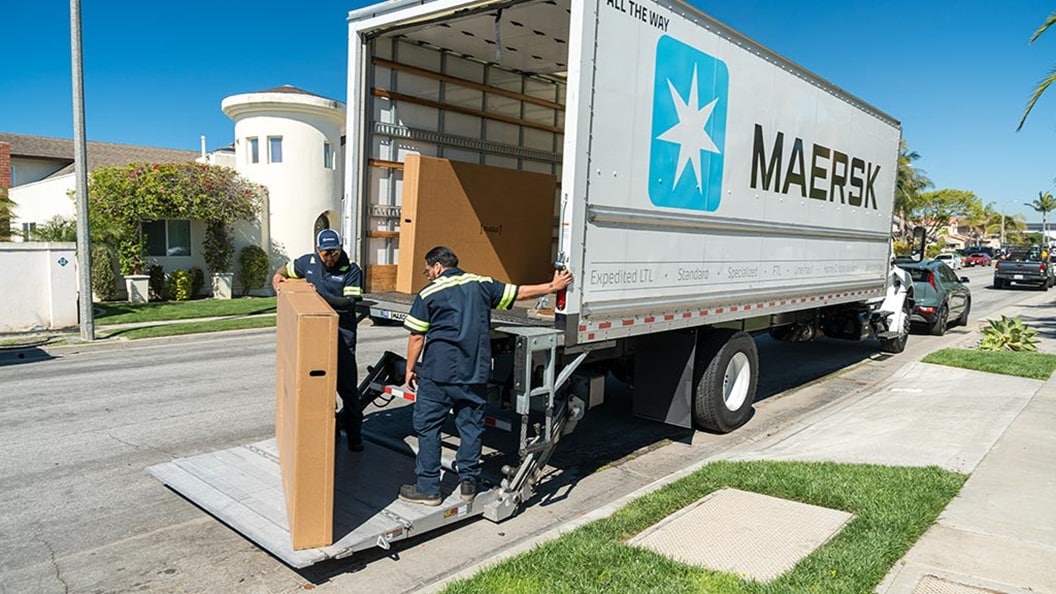
- If the driver knew how to manage a two-person lift
- If the support team had visibility when issues popped up
- If the customer felt informed, respected, and valued
Nor does it explain the ripple effects that unfold when a delivery stalls operations or ruins a customer interaction, the kinds of mishaps that create unnecessary drama. Those are the real moments where trust is built — or broken.
It happened to us… One national retailer switched to a lower-cost provider to save $100K a year. Within six weeks, they had already incurred $ 500,000 in fallout due to missed installations, SLA penalties, and failed deliveries. Their ask to Maersk? “This provider is falling flat. They just don’t know how to do these deliveries. Can you step in and fix this for us?”
According to reports by Statista, retailers lose an average of $17.20 per order due to failed domestic deliveries, stemming from factors like re-delivery efforts, wasted fuel, and customer service expenses. That’s the hidden bill behind the ‘on-time’ checkbox as your only lens.
Why complex freight needs a different standard
In Specialized LTL and Heavy-Bulky Delivery Services, the stakes are different.
These aren’t just large shipments. They’re high-value assets — fragile, oversized, sometimes requiring assembly — delivered to homes, showrooms, or operational sites where expectations are high and second chances are rare. You’re not just moving freight. You’re delivering customer experience and a brand promise. According to Forbes, 98% of consumers say that the delivery experience impacts their brand loyalty.
And that’s where frontline execution is crucial.
We’re that last line between our retail partner, their whole supply chain, and getting goods to their final customer. We’re stepping into people’s homes. It’s a personal, crucial, and sensitive area. And we treat it that way. That’s the most important aspect of what we do and how we operate things.
A study by McKinsey shows that consumers are ranking reliability of delivery higher than speed of delivery as a key metric to their satisfaction. So, reliability then becomes a system designed to protect the customer experience — from the warehouse floor to the living room floor.
What does a reliable, drama-free delivery in ground freight look like
Real reliability is built upstream — in how you plan, how you coordinate, and how you recover. These four dimensions are what determine ‘reliability’ in specialized ground freight deliveries and make them smooth and drama-free.
- Performance reliability
- Condition reliability
- Transparency reliability
- Execution reliability
Your system should work before the truck even moves. Yes, on-time delivery still matters. However, it must be supported by proper route planning, accurate volume forecasting, and optimal capacity allocation.
What Maersk does differently: We forecast volumes at origin and staff accordingly. On big promo weekends, load managers are already on-site, not scrambling after the fact.
The freight may arrive. But did it arrive in one piece and without turning into a liability? Specialized freight requires specialized handling. That includes securement, padding, packaging, and SOPs that prevent damage between handoffs, where most issues happen.
What Maersk does differently: We document conditions with real-time photos at every handoff and milestone — origin, mid-transit, and delivery — and any divergences are flagged instantly.
You can’t fix what you can’t see. Portals and tracking links aren’t enough. Real transparency means proactive updates, milestone alerts, and live escalation paths, so your team sees risk before your customer does.
What Maersk does differently: Driver location tracking feeds CX and ops. Escalations are routed live to response teams. Well-defined SOPs, so issues are spotted early and handled fast.
When things go wrong (and they will), who takes responsibility? Reliability isn’t perfection. It’s how your partner responds and how they handle problems. And whether your brand is protected or left exposed.
What Maersk does differently: We follow a structured escalation protocol. Human accountability. Trained field response. Teams are trained to step in and solve problems. And a simple principle: fix it fast, visibly, and fully.
Why reliability matters in Specialized LTL and Heavy-Bulky Delivery Services
Because we’re talking about products that can’t be replaced easily. Kitchen appliances, commercial displays, industrial equipment, oversized furniture — that travel hundreds of miles and land directly in the hands of your customer. These deliveries must be right the first time.
In specialized LTL, that looks like:
- National, region-wide, and local deliveries for a single retailer, coordinated across lanes, depots, and delivery windows.
- Dedicated trucks with complex routing, where how it’s packed and handled changes the outcome.
It happened to us… A large retail store chain had a major blowout sale that more than doubled their normal volumes. Our proactive capacity planning, with accurate forecasts and daily communication calls between division heads, along with strategic resource positioning at origin stations, prevented systemic backlogs, enabling us to deliver reliably across the US.
In heavy-bulky delivery services, that looks like:
- A driver who is also your frontline ambassador, handling complex installations, narrow hallways, and real-time problem-solving.
- Assembly, setup, and in-room delivery, where every action is a brand moment.
You’re not just moving freight anymore. You’re managing a customer experience. And that experience has a brand attached to it… yours.
Why most freight providers can’t deliver this reliability
Because they weren’t built for it.
The industry still builds for time, not trust. Most providers can get it there on Friday. But few can do it with transparency, coordination, and care. Because many providers:
- Have fragmented networks without standardization and limited handoff control
- Outsource escalations to third parties with no visibility into your shipment
- Don’t invest in driver training or customer interaction standards
- Cannot offer clarity about what happened, where, when, and why
And that’s why delivery fails… at the doorstep.
Miles that matter: what it looks like in practice
At Maersk, we’ve designed our premium ground freight services around a simple belief: Reliability isn’t a metric. It is an experience.
Every mile has to matter:
- The miles from depot to dock, where condition is preserved.
- The miles in transit, where real-time data can prevent disruptions.
- The miles at the doorstep, where your brand shows up in person.
Because in specialized freight, “Delivered. On-time.” is not good enough. And reliability, for us, means making every mile drama-free — predictable, transparent, and cared for.
We don’t sell fast. We sell right. Every handoff, every hour, every zip code.
Testing reliable delivery: 5 questions you need to ask
- Is your provider reliable because they say so, or because their system is built that way?
- Can you see and trust every step, or do you only find out something’s wrong after the customer does?
- Do they have escalation playbooks and personnel to handle everything, or just support tickets and shared inboxes?
- Are their last-mile partners seamlessly coordinated, or stitched together with gaps?
- If you assessed them on performance, condition, transparency, and execution, would they hold up?
Because reliability isn’t just what shows up at the door, it’s what shows up when things go wrong. And the right logistics partner knows how to deliver on both. That’s what Maersk Ground Freight was designed for. From cross-regional specialized LTL to high-stakes doorstep deliveries, we have built our systems around trust, coordination, and brand protection, not just transit. Discover how it works.
Interested in specialized LTL services in North America? We deliver the extra care that transforms your one-time buyers into repeat customers. Contact us to get tailored advice that best suits your business.