 LinkedIn
 WeChat
Your supply chain is global. Your customer experience is local. But the system that runs one was never built to protect the other.
You sourced the item. Shipped it. Cleared customs. Managed container slots, demand spikes, port delays. And at the very end—the moment your customer actually cares about—you hand it off… to a domestic network that was never designed to carry the experience.
Let’s talk about that.
Why your first mile and final mile stop talking
For most shippers, the supply chain still operates in two distinct worlds.
- There is the global journey: structured, industrial, planned months in advance—defined by weeks on the water and massive freight volumes.
- Then, there is the domestic last mile: compressed, fragmented—operating on 24-hour cycles and consumer volatility that shifts by the click.
Most supply chains are built like relay races. The first mile runs clean. The ocean leg runs disciplined. Then the baton is passed and the rules change. The ocean carrier steps back and a network of domestic parcel providers steps in—often disintegrated and disconnected. The result? A gradual loss of visibility with each handoff. Responsibility fragments. And what was once a controlled flow turns into a handoff-heavy black box.
The irony is that the part your customer directly experiences is the part you plan the least.
Parcel delivery in 2026: What changed & what’s at stake?
The North American e-commerce market is transitioning. For a long time, the strategy for medium-to-large sized (M-L) businesses was simple: select a major parcel delivery service partner, negotiate the best volume discounts, and optimize for speed and cost. For many, that model worked—at least well enough. Until it didn’t.
Over the last few years, something fundamental has changed in ways that go beyond volume growth or peak pressure. And the old parcel strategy isn’t working as well. What once worked through scale and predictability is now being tested by volatility. Here’s why:
- Parcel didn’t get harder because volumes grew. It became complex because everything around it fragmented.
- E-commerce fulfillment happens across multiple nodes.
- Inventory, thus warehousing, is no longer centralized.
- Carriers operate at different strengths across regions.
- Customer expectations vary by channel, geography, and promise.
- Exceptions now matter as much as ‘on-time’ deliveries.
- Your e-commerce ‘costs’ aren’t just shipping rates. It’s coordination, customer expectations, and brand equity on the line.
- A missed scan can cascade into customer service escalations.
- A delayed handoff can trigger refunds or chargebacks.
- A silent exception can damage trust long before a delivery date is missed.
- It’s 2026. But your parcel strategy is still stuck in a 2018 mindset.
- Since 2019, the domestic parcel landscape has undergone a radical shift with the regional carrier market growing by 22.6% year-on-year, according to the Pitney Bowes Shipping Index. That’s huge!
- Today, if your parcel delivery strategy is still reliant solely on a single national network, you may be operating under a false sense of resilience while still being exposed to single-network caps, surcharges, and rigidity.
- Smart e-commerce shippers have moved from volume consolidation to network orchestration—using the right e-commerce logistics partner for the right lane.
It’s easy to assume parcel delivery became complex because e-commerce exploded. That’s part of the story, but not the complete one. Here’s the lesser known anti-climax:
What used to be a linear flow has become a network. And networks behave very differently from pipelines.
In modern e-commerce logistics operations, parcel delivery sits at the intersection of customer experience, cost predictability, risk management, and brand trust. You’re not just shipping a parcel. You’re shipping your brand.
Add to that the operational overheads: finance teams reconciling multiple invoices, technical teams maintaining disparate integrations, safety stock held because inbound visibility can’t be trusted. That’s dozens of interdependent decisions—made daily—while still being accountable for the customer experience.
Keeping your first mile and final mile separated has a price tag, and a costly one. But it’s rarely visible on a rate card. That’s why parcel strategies are no longer about how fast something moves, but how efficiently the system actually performs under real-world conditions.
For decades, the ‘safe’ choice for enterprise shippers was simple: consolidated volume with one of the legacy-national carriers. It felt secure. It felt predictable. But the market has moved on, and many e-commerce strategies haven’t kept up.
The focus has shifted from “Who is your carrier?” to “How diverse is your network architecture for your e-commerce flows?”.
From the 2018 mindset to the 2026 strategy: The evolution of parcel delivery
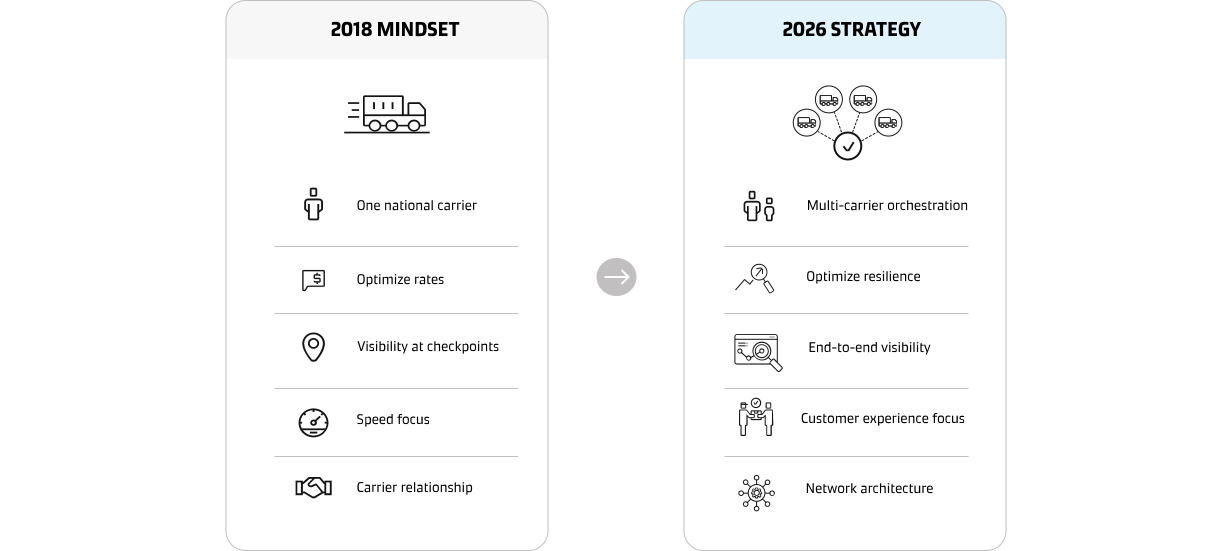
A better question than “How fast or cheap?”
While speed and cost remain important, they are symptoms of a well-designed system—not the strategy itself. To evaluate the maturity of your parcel operations, ask these questions:
- Who owns the outcome? When a regional carrier underperforms, does your parcel partner resolve the issue, or do they forward you the ticket?
- Is the system rigid or fluid? Can you reroute meaningful volume to avoid disruption without needing to engineer or rearchitect the entire setup?
- Is the flow continuous? Does your forecasting data from the ocean transport inform your domestic injection strategy, or does your visibility fade once the container hits port?
- Is your team managing carriers or customers? Where does most of your operational time go—coordinating providers or protecting customer expectations?
These are system-level questions. And they require system-level answers.
What your e-commerce parcel system actually requires
E-commerce parcel delivery operates under the same realities as global trade: distributed execution, interconnected systems, and the need for clear accountability and coordination. Treating parcel delivery as a system, thus, changes the outcome. It requires:
- Central accountability: One party must own the end-to-end outcome, regardless of how many partners execute along the way.
- Network breadth without customer complexity: Multiple regional carriers may be involved, but the experience should feel unified, commercially and operationally.
- Visibility that prioritizes exceptions: Not just event tracking, but the ability to flag when something isn’t happening as expected.
- Human escalation paths: Automation and technology enables scale, but people still resolve the most brand-critical moments.
- Ability to adapt without re-architecting: Seasonality, promotions, and disruptions shouldn’t require rebuilding the operations each time.

One Partner owns the outcome end-to-end.


Real-time visibility to act before it impacts the customer.

Expert teams to resolve issues fast when automation isn't enough

Beyond just features, they’re basic design principles in an e-commerce parcel logistics system. To your customer, the experience is seamless. To the operations team, the complexity is absorbed. This is where Maersk E-commerce naturally fits—not as a departure from Maersk’s legacy, but as an extension of it.
The Maersk lens: A familiar name… in a new lane!
We believe that while the backend should be diverse, the frontend must be singular. So, rather than relying on a patchwork of fragmented regional carriers or rigid single-provider models, we integrate the best of both under a single digital and operational roof. Maersk offers a third way: the flexibility of a multi-carrier network, delivered with the accountability, control, and simplicity of a single partner.
Whether a parcel moves through three regional partners or thirteen, you ship with Maersk. Responsibility remains centralized. The backend adapts, the frontend stays simple. This means:
- Unified accountability: Whether your package moves via a regional specialist or a national line-haul, Maersk remains the sole point of contact for you. We take the responsibility for the routing, the coordination, and the delivery.
- Auto-rerouting: If a specific sortation hub or regional provider hits a volume surge or weather delay, our software triggers an automatic reroute to an alternative injection point. No manual tickets or phone calls required from your end.
- Human element in an automated world: While technology provides the visibility, it is the expertise behind the screen that ensures execution. Our teams manage hundreds of daily exceptions, resolving issues before they reach your consumer’s doorstep.
- Predictable economics: By negotiating through Maersk’s aggregate network volume (moving millions of parcels annually), shippers can access a level of pricing stability and ‘parcel-level’ discipline that is often out of reach when negotiating as a single entity.
For you, this means…
You don’t manage 17 different carrier relationships.
You don’t track 17 different service level agreements.
And you don’t reconcile 17 different invoice formats.
You manage one relationship with us—Maersk—all the way.
We orchestrate the routing, the injection, and the exception management. If a regional partner faces a weather delay or another local partner isn’t available, it is our problem—not yours. Our system identifies it and adjusts. Your e-commerce supply chain ‘flow’ continues uninterrupted.
You know Maersk for your containers. Now, let us handle your brown boxes too!
Why trust a company known for massive ocean containers with a 5lbs e-commerce parcel?
- Because your supply chain shouldn’t have to restart every time it hits a new border or a new state line or changes a transport mode.
- Because the discipline required to move global trade is exactly what the volatile parcel market needs right now.
- Because while we’re moving boxes, big and small, you can always trust us to deliver your brand promise along with it.
And because we’re not here to replace what worked before, but to operate parcel the way it actually works today—a continuous, accountable system designed to scale with your business.
At Maersk, we bring our reliable ocean logistics approach to e-commerce logistics. We apply the same rigorous planning, flexible forecasting, and capacity management used in global ocean freight to your domestic deliveries. Our parcel delivery service is purpose-built for high-volume, brand-sensitive e-commerce shippers with full-scale orchestration of your supply chain. Make your first mile and final mile work together. Discover our e-commerce parcel delivery services in North America.